Iran Fires Ballistic Missiles at Diego Garcia, Revealing a Capability It Had Denied Possessing
While both missiles failed to reach their target, the strategic implications of the attempt matter more than the result.
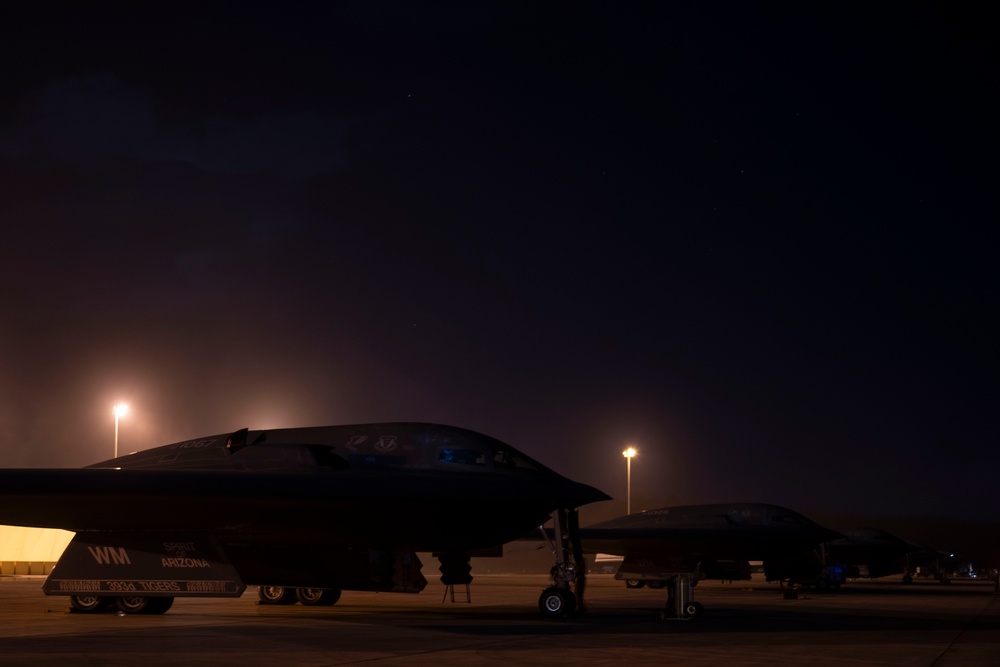
Diego Garcia is a coral atoll in the middle of the Indian Ocean, roughly equidistant between the east coast of Africa and the western tip of Indonesia. It rises barely a few feet above sea level. It has no indigenous population. And it hosts one of the most important pieces of American military infrastructure on earth: a naval support facility, an airfield that can launch B-2 and B-52 bombers, pre-positioned supply ships, and intelligence collection facilities that have supported every major U.S. operation in the Middle East since the Gulf War.
The base's security has always rested on a simple assumption: it is too far away to hit. On Friday, Iran tested that assumption.
Two intermediate-range ballistic missiles, fired from Iranian territory, targeted the installation. A Navy destroyer intercepted one. The other failed in flight. No damage. No casualties. The attack was a military failure.
Strategically, it was a revelation.
The Range Problem
Iran has maintained for years that its ballistic missile program tops out at roughly 1,200 miles. Tehran has cited this ceiling in diplomatic settings to argue its missiles pose no threat to Europe. That ceiling was either a deliberate lie or became obsolete without public acknowledgment.
Diego Garcia sits approximately 2,500 miles from Iran. A missile that can reach it can reach southeastern Europe. Most of the Arabian Peninsula. The eastern coast of Africa. The geometry is unforgiving. The Department of Defense confirmed the missile type as a previously unobserved variant of the Khorramshahr series, assessed at a range of roughly 4,000 kilometers. Conventional warhead.
Intelligence analysts are now asking the questions that should have been asked before: How many does Iran have? Can they carry a nuclear warhead? How long has the program been operational? The answers reshape the threat calculus for NATO's southern flank, for every U.S. installation across the Middle East and Central Asia, and for allied nations throughout the Indian Ocean.
Why This Atoll
Diego Garcia's value derives from its remoteness. Unlike facilities in the Persian Gulf, which operate under layered air and missile defense, the atoll relies primarily on distance for protection. There is no Patriot battery covering it because, until Friday, no adversary in the region had the range to threaten it.
That assumption is dead. Iran's targeting of Diego Garcia was a message, and the message was not subtle: American power-projection assets are not safe because they are far away. The message was aimed at Washington, but every country hosting a U.S. base heard it too.
Air Supremacy and Its Asymmetries
The Diego Garcia strike arrived the same day the Pentagon confirmed that A-10 Warthogs and Apache attack helicopters are now flying close air support missions over Iran. These aircraft operate low and slow. They are viable only when the enemy's air defense network has been effectively destroyed.
Their deployment confirms what the Department of Defense has been claiming: the U.S. and Israeli air campaign has degraded Iran's conventional military by approximately 90 percent. Air force gone. Radar network gone. Surface-to-air missiles dismantled. What remains of Iran's capacity to fight back is its ballistic missile arsenal, its proxy networks, and its ability to threaten shipping.
The Diego Garcia strike fits this pattern precisely. Iran cannot contest American airpower over its own territory. What it can do is lob missiles at distant targets and hope that one penetrates the defense. It is the strategy of a military that is losing and knows it. It is not, however, without risk. A single missile with a sufficiently destructive warhead reaching a target like Diego Garcia could produce significant casualties and damage. The fact that Friday's attempt failed does not mean the next one will.
The Defense Question
The USS Boxer, an amphibious assault ship carrying several thousand Marines, departed San Diego this week for the Gulf region. Its deployment signals either preparation for a ground component or a desire that Tehran believe one is coming.
The immediate problem is whether naval missile defense assets in the Indian Ocean can defend Diego Garcia against a sustained barrage. One successful intercept does not validate a defense. If Iran has a stockpile of these longer-range missiles, repeated salvos could overwhelm available interceptors.
The Pentagon will need to reassess the threat to every U.S. installation within the newly revealed range envelope. That is a large number of bases across a very large stretch of the globe, from the eastern Mediterranean to the western Pacific.
The War's Expanding Geometry
Three weeks ago, the threat picture was Iranian fast boats and coastal missiles in the Persian Gulf. Today it includes intermediate-range ballistic missiles targeting bases in the Indian Ocean. Next week it could be something else.
Prolonged conflicts produce surprises. They also produce escalation ladders that neither side anticipated at the start. Every additional week of operations gives Iran incentive to reveal capabilities held in reserve, to reach further, to draw the war outward from the Gulf to a global theater.
The initial strikes were justified. Iran's pursuit of nuclear weapons, its four decades of killing Americans, its destabilization of the region through proxies and terror: all of it made military action a question of timing, not principle. But the case for starting a war and the case for prolonging one are different arguments, and the second one gets harder with every new surprise.
The administration's stated objectives have been largely achieved. The nuclear infrastructure is wrecked. The conventional military is degraded beyond operational relevance. What remains is the question of whether the outstanding objectives (proxy networks, missile stockpiles) justify an open-ended campaign that is producing new risks faster than it retires old ones.
Friday's missiles missed Diego Garcia. The next ones might not miss their targets. The war's geometry is expanding, and nobody in Washington has explained where the edge of the map is.
Related Stories

Muscat Round 3 Ends Without Framework Agreement
The third round of indirect U.S.-Iran talks ended in Muscat on Friday morning without the framework agreement Witkoff had been seeking. The Iranian delegation departed for Tehran.
May 15, 2026 · 5 min read

U.S. Destroyer Confronts Iranian Fast Boats in Hormuz
The USS Truxtun drove off four Iranian fast boats approaching a Liberian-flagged tanker in the central Strait on Saturday, in the most serious non-kinetic confrontation since the blockade began.
May 9, 2026 · 6 min read

Witkoff Is in Muscat for the Third Round of Iran Talks
Special Envoy Steve Witkoff arrived in Muscat on Sunday morning aboard a commercial Emirates flight from Dubai, joining Iranian Foreign Minister Abbas Araghchi in a city where the Sultan's protocol forbids public confirmation of negotiations until both sides authorize disclosure, and where the substantive work of the third round of indirect U.S.-Iran talks has now begun under conditions that neither government would publicly acknowledge for several days.
May 4, 2026 · 7 min read